Observe daily
Give managers a simple way to capture obvious damage, abnormal operation, cleanliness and member-reported concerns.

FREE MAINTENANCE CHECKLIST
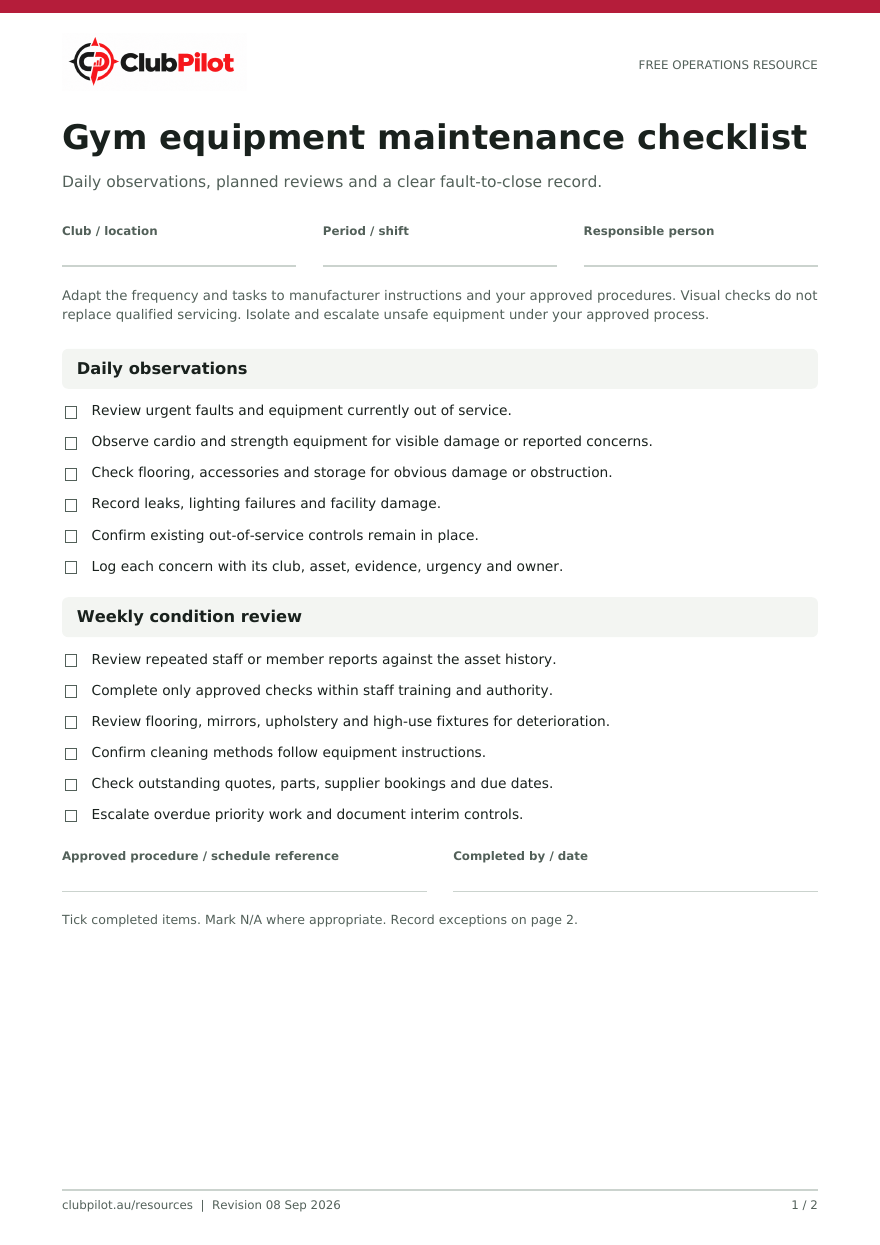
Use this guide to shape daily observations, weekly condition checks and planned monthly review. Always follow manufacturer instructions, competent-person requirements and your approved maintenance and isolation procedures.
By Callan, ClubPilot · Updated
Free PDF · Print and adapt · No sign-up required
AT A GLANCE
Give managers a simple way to capture obvious damage, abnormal operation, cleanliness and member-reported concerns.
Use approved equipment and facility checks at a frequency supported by risk, use and manufacturer guidance.
Keep the fault, approval, supplier, cost and completion evidence together instead of ending at ‘someone was told’.
WORKED RECORD EXAMPLE
Sample record CP-1042 identifies Treadmill 07 at Location 02, the reported condition, evidence and current owner. As the job progresses, the same record retains the approval, supplier hand-off and completion evidence. That lets the next person understand what happened and what still needs action without searching through messages.
Open the fictional workspace and select a job to see its owner, evidence and history.
Open pageFROM PAPER TO A SHARED RECORD
The free two-page PDF is a printable starting point with periodic checks and a fault follow-up table. Set the actual schedule from the equipment instructions and your approved programme.
See how ClubPilot connects faults, evidence, approvals, suppliers and verified completion across locations.
Open pageUse a separate shift routine for cleaning and presentation.
Open pageIMPORTANT BOUNDARY
The final maintenance programme must identify tasks reserved for the manufacturer, supplier, electrician, technician or another competent person. Staff should never dismantle, energise or repair equipment outside their authority and training.
SETTING THE SCHEDULE
No single interval suits every gym. Agree the schedule for each asset category from the inputs below, record who approved it and revisit it when usage or condition changes.
FAULT PRIORITIES
Shared priority levels help staff decide quickly and help leaders compare locations. Set your own response targets for each level and make sure everyone knows who can change a priority.
COMMON GAPS
Missed repairs are rarely caused by a lack of effort. They happen at the hand-offs between the person who noticed the fault, the person who approves the cost and the supplier who does the work.
PRACTICAL CHECKLIST
This operational guide is a starting point. Your approved procedures, leases, manufacturer instructions and legal duties remain the source of truth.
STRAIGHT ANSWERS
Frequency depends on manufacturer instructions, equipment type, usage, condition, risk and applicable requirements. Use this guide only as a starting structure and have the final programme approved by the appropriate competent people.
Only when the task is authorised, within their training and consistent with the manufacturer and approved procedure. Electrical, structural, guarded or safety-critical work may require a qualified supplier or competent person.
At minimum: location, asset, observed fault, date, urgency, evidence, interim control, owner, decisions, supplier or parts status, costs and verified completion history.
Enough for anyone to understand the control: the asset, the date, a brief reason, who applied it and who may remove it. Record the same details in the fault record so the notice is not the only evidence that the item is unavailable.
Consider replacement when repeat faults, downtime, parts availability, repair cost or the manufacturer's advice suggest further repairs are poor value or no longer suitable. Keeping cost and fault history with each asset makes that decision easier to justify.
Someone authorised under your procedure, usually the responsible manager, confirms the item works as expected and that the supplier's service evidence is attached. Safety-critical work may need confirmation from the competent person who completed it.
FREE RESOURCES
Separate member administration from operations and franchise oversight before you shortlist.
A printable routine for opening, the active shift, closing and manager review.
Prepare a walkthrough, capture useful evidence and assign follow-up.
Access, safety, presentation and end-of-day security checks.
Standards, roles, recurring work and leadership review across locations.
Plan monthly local area marketing with owners, budgets and results.
A PRACTICAL NEXT STEP
ClubPilot keeps the fault, evidence, approval, supplier, cost, owner and verified close together across authorised locations.